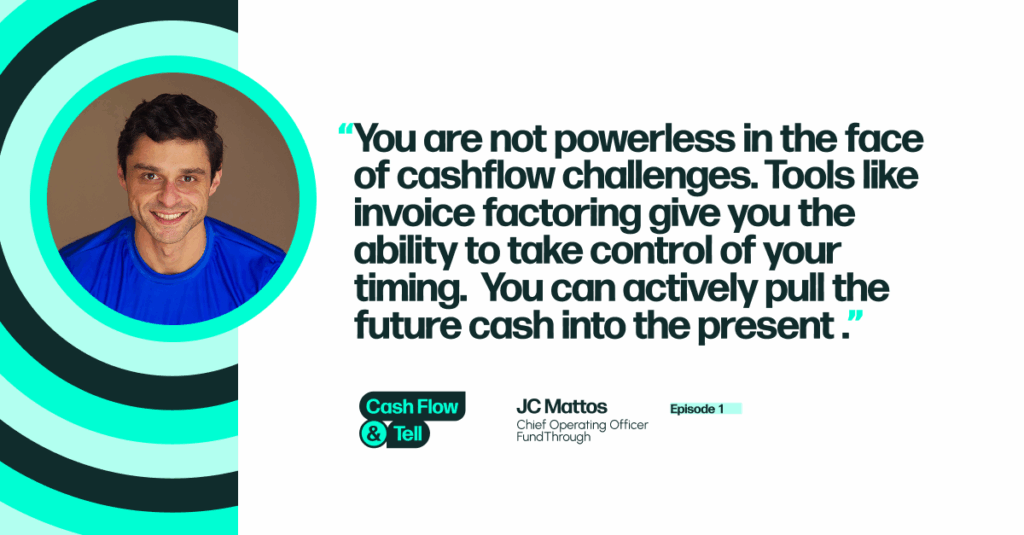
Sourced from: JC Mattos, COO of FundThrough, Host of Cash Flow & Tell, Ep 1: You Delivered. So Why Are You Still Waiting to Get Paid? (Guide last updated January 2026)
Invoice factoring is widely misunderstood: myths, half-truths and flat-out misinformation run rampant. This guide seeks to bring clarity to the topic and answer every question you could have about factoring once and for all. The information here comes from factoring expert and FundThrough COO JC Mattos, in Episode 1 of FundThrough’s podcast, Cash Flow & Tell.
Key Takeaways: Invoice Factoring Explained
- Invoice factoring turns unpaid B2B invoices into immediate cash, often within hours, instead of waiting 30–90+ days for payment.
- Businesses sell invoices to a factoring company, receive an upfront advance (typically 80–95%), and get the remainder minus fees once the customer pays.
- Invoice factoring is not a loan. It’s the sale of an asset, so it usually doesn’t add debt to your balance sheet.
- Factoring fees typically range from 1%–4% per invoice, depending on risk and how long the customer takes to pay.
- It’s best suited for B2B companies with long payment terms, upfront costs, and creditworthy customers where growth is constrained by cash flow timing, not demand.
What is invoice factoring and how does it work?
Invoice factoring is a way to turn unpaid B2B invoices into cash right away. Instead of waiting 30/60/90+ days for your customer to pay, you sell the invoice to a factoring company (a.k.a., a factor). The factor advances most of the invoice value upfront, then collects payment from your customer later—finally, the factor sends you the remainder minus fees.
“Invoice factoring lets you turn your pending invoices into immediate cash. You sell that invoice to a factoring company,” according to FundThrough COO JC Mattos. “[They] will advance around 80% to 95% of the A/R within hours.”
A practical way to think about it: factoring unlocks working capital that’s already earned but “stuck” in accounts receivable. This matters because cash flow gaps are often what kill otherwise-healthy small businesses Oftentimes this is quantified as 82%.
Is invoice factoring a loan?
No, traditional invoice factoring is not a loan. The key difference is ownership: with factoring, you’re typically selling an asset (the invoice) rather than borrowing money that must be repaid on a schedule.
“Invoice factoring is not a loan,” said JC. “You’re selling an asset, in this case the invoice… This means there’s no debt added to your balance sheet.”
That said, some products marketed as “invoice finance” are structured more like lending (e.g., AR lending), where you keep ownership of the invoice and repay an advance against it. A finance product strictly described as invoice factoring is not a loan, but related products do function like lending.
What’s the difference between invoice factoring and a loan?
The main difference between invoice factoring and a loan is that factoring involves selling unpaid invoices to a third party for immediate cash, while a loan involves borrowing money to be repaid with interest. Factoring relies on customer payments, while loans depend on creditworthiness and repayment terms.
Comparison: Invoice factoring vs loan
|
Feature |
Invoice factoring |
Traditional loan |
|---|---|---|
|
What it is & How it works |
You sell unpaid invoices to a factor for an advance on your accounts receivable. |
You borrow money from a lender and repay it over time. |
|
Primary underwriting focus |
Your customers’ creditworthiness and payment reliability (ability to pay the invoice). |
Your business and/or personal credit, financials, cash flow, and collateral. |
|
Repayment structure |
No scheduled principal-and-interest payments from you; your customer pays the invoice to the factor on net terms. (Unless they default.) |
Scheduled repayments (principal + interest) from you to the lender. |
|
Balance sheet impact |
Not recorded as debt since it’s the sale of receivables; adds cash to balance sheet. |
Adds debt to your balance sheet. |
|
Collections / AR management |
Factor handles collections and A/R management, reducing admin work. |
Lender does not manage your A/R; you keep collections and A/R application responsibility. |
|
Best-fit situations |
Fast-growing, seasonal, or cash-flow constrained by net payment terms; businesses tired of “acting like a bank” for creditworthy customers. |
Businesses with predictable cash flow needing capital for broader uses (expansion, equipment, refinancing, etc.). |
|
Cost presentation |
Often quoted as a fee per invoice or by net term length, e.g., 2.75% per Net 30 terms. |
Quoted as interest rate/APR (plus lender fees). |
|
Best way to compare cost |
Compare total dollars paid against revenue growth enabled and savings on collections agency fees and/or A/R employees. |
Compare total dollars paid over the life of the loan (APR + fees). |
How much does invoice factoring cost?
Invoice factoring typically costs between 1% to 5% of the invoice value per month. The exact rate depends on the client’s industry, invoice volume, customer credit risk, net term length, and the factoring company’s terms. Some providers also charge additional fees for processing, setup, or late payments.
A useful way to sanity-check cost is to translate the fee into an “effective annualized” cost—because a 3% fee for 30 days is very different from 3% for 90 days. But you should also compare it to value of revenue growth unlocked and the value of timing: avoiding missed payroll, buying inventory, or capturing a time-sensitive discount. Hidden fees are also usually part of total invoice factoring cost. These vary based on the factor and the client’s situation.
As FundThrough COO JC Mattos frames it, “Think of factoring fees as the cost of speed and flexibility”. Learn more about invoice factoring rates.
See if getting paid early is right for you
What fees are typically associated with invoice factoring?
The core cost is the factoring fee (often called a discount rate), which is the amount the factor keeps when the invoice is paid. The podcast describes it as 1% to 4% (though up to 5% is common) and notes the exact price within the range varies with term length and risk.
Beyond that, depending on the provider and contract, you may see:
- Wire/ACH fees: to send advances
- Service or maintenance fees: monthly minimums, account fees
- Origination or underwriting fees
- Early termination fees: if you’re locked into a term contract
- Same-day funding fees: as a rush charge
- Site visit fees: Some factors still meet you in person as part of due diligence.
Because of these extra fees, the advertised rate may not reflect the all-in cost. So the best practice is to ask for a pricing breakdown showing: fee structure, funding minimums, non-recurring fees, and penalties for late customer payments.
Which invoice factoring companies offer the best rates for small businesses?
The best invoice factoring companies for small businesses offering low rates include FundThrough, altLINE, and Scale Funding. These companies provide competitive rates with flexible terms, fast approvals, and little to no hidden fees. Rates vary based on industry, volume, and customer credit.
Comparison: Best invoice factoring company rates
Provider | Factoring rate | Advance rate | Additional fees or terms to consider |
|---|---|---|---|
FundThrough | 2.2%-3% per 30 days | 100% minus factoring rate fee | Typically no long-term factoring contract (spot factoring) or additional fees. |
altLINE | ~0.5%–3% | 80%-90% | Origination fee: $150–$500 |
RTS Financial | Not publicly disclosed | Up to 97% | Trucking industry focused; fuel card program available |
eCapital | Not publicly disclosed | Not publicly disclosed | Early termination and minimum invoice fee |
Scale Funding | Not publicly disclosed | Not publicly disclosed | 30 year track record in factoring |
Riviera Finance | Not publicly disclosed | Up to 95% | 6-month contract is standard; non-recourse factoring available |
Universal Funding | 0.55%-2% per 30 days | Up to 95% | Credit approval, lock box, outgoing wire fees |
Practical approach to get the best rate for you:
- Start with a shortlist that matches your industry or needs (e.g., trucking specialists or tech-enabled factoring that integrates with accounting platforms).
- Compare all-in cost (rate + minimums + fees), not just the headline discount rate.
- Ask how pricing changes with faster-paying customers or higher monthly volume.
- Confirm whether you can factor select invoices (spot factoring) or must commit your whole ledger.
- Collect several offers for comparison and negotiating leverage.
Is invoice factoring a good idea for small businesses?
Invoice factoring is a good idea when cash is tied up in receivables and growth is constrained by timing, not demand. According to FundThrough COO JC Mattos, many businesses are “doing everything right on paper” but their working capital is “locked up in accounts receivable”. Factoring can convert that lock-up into usable cash quickly.
Factoring is also a way to stop missing opportunities: paying a 2% fee can be worth it if it allows profitable growth or prevents operational disruption.
When factoring is usually a fit:
- You sell B2B on net terms (30–90+ days)
- You have reliable, creditworthy customers, but slow payment cycles
- You need working capital to fund payroll, materials, equipment, or big projects that will grow your business
When it’s often not ideal:
- Your margins are too thin to absorb fees
- You have frequent disputes/chargebacks
- Your customers are consumers (B2C) or very high-risk
What is an example of invoice factoring?
- A business issues a $100,000 invoice to a customer with net 60 payment terms.
- The invoice is sold to a factoring company, which advances 85%–95% of the invoice value immediately.
- In this example, most of the cash (up to $85,000–$95,000) is received upfront, often within hours.
- The business’ customer pays the full $100,000 invoice to the factoring company according to the original net terms.
- The factor deducts a $2,000 factoring fee from the remaining balance.
- The business receives the remaining reserve, resulting in $98,000 total received on the $100,000 invoice.
- In a real-world scenario shared in the podcast episode, a manufacturer ships an order and within a few hours, about 85% (or more) of the invoice value is deposited into her bank account, allowing her to pay suppliers and staff without waiting months.
- This invoice factoring example highlights its two-part payment structure: cash advance now, reserve paid later.
How fast can you get paid with invoice factoring?
With invoice factoring, businesses can get paid within 24 to 48 hours after submitting invoices. Approval speed depends on the factoring company’s processes, client follow-up time, and customer responsiveness. Some providers offer same-day funding once the account is set up and invoices are verified.
Speed depends on:
- The factor’s underwriting efficiency
- Your speed in providing necessary documents
- Your customer’s responsiveness in verifying the invoice.
In practice, first-time setup can take days to weeks because the factor needs documents, customer verification processes, and legal paperwork. After that, many businesses experience same-day or next-day funding for eligible invoices, especially when submitting invoices digitally. (Fit Small Business).
What types of businesses use invoice factoring?
Factoring is most common in B2B industries with long payment terms and upfront costs. A few examples
- Manufacturing with net terms of 60-90 days
- Oil & gas services and suppliers with 60–120 day terms and late payments
- Trucking and logistics, where fuel and payroll are immediate but broker payments lag
- Professional services (e.g.,consulting, agencies, firms) working for big enterprises
“The global factoring services market size was estimated at USD 4,185.05 billion in 2023 and is expected to grow at a CAGR of 10.5% from 2024 to 2030. The market has been experiencing steady growth in recent years, owing to the increasing demand for alternative financing options among small and medium enterprises.” –Grand View Research, Factoring Services Market Size Share & Growth Report 2030
See if getting paid early is right for you
Is using invoice factoring considered a negative by a company’s clients?
Often, no—especially in industries where factoring is common. Customers may simply be asked to remit payment to a different address or account, and “might not even notice anything different except sending the payment to a financing company’s address,” per FundThrough COO JC Mattos.
That said, perception depends on execution. If the factor communicates professionally and disputes are handled professionally in cooperation with the client, many large companies treat it as routine. Where it can go wrong is when the customer experience is sloppy (confusing notices, aggressive collections, repeated verification calls, etc.). That’s why it’s smart to choose an established factoring company with clear processes for customer communications.
Protip: Work with a factor that empowers you to tell customers proactively that you’re updating remittance instructions, and ensure the factor’s tone matches your brand.
Does invoice factoring hurt your credit?
Factoring is not reported the same way as a term loan because it’s often structured as the sale of a receivable rather than debt—so it may not hurt credit in the way missed loan payments do. Factoring isn’t a loan and doesn’t create the same repayment obligation on your balance sheet.
However, credit impact can still happen indirectly: If your factor files a UCC-1 lien (common in receivables financing), having a lien on your receivables could effect your ability to get other types of funding.
Bottom line: factoring is generally credit-neutral to credit-positive when it stabilizes cash flow, but you should ask any provider what (if anything) is reported and what legal filings are involved.
What’s the difference between recourse and non-recourse factoring?
The main difference between recourse and non-recourse factoring is who assumes the risk of non-payment. In recourse factoring, the business must repay the factor if the customer doesn’t pay. In non-recourse factoring, the factor absorbs the loss if the customer defaults, offering more protection but higher fees.
Comparison: Recourse factoring vs non-recourse factoring
Feature | Recourse factoring | Non-recourse factoring |
|---|---|---|
Who bears nonpayment risk | The business ultimately bears the risk if the customer does not pay. | The factoring company assumes nonpayment risks. |
What happens if the customer doesn’t pay | You typically must buy back the invoice or replace it with a new eligible invoice(s). | The factor may absorb the loss, depending on the reason for nonpayment. |
Scope of coverage | No protection against customer nonpayment. | Protection against non-payment is limited and defined by contract. |
Commonly covered scenarios | Not applicable—business is responsible in all cases. | Often covers customer insolvency or bankruptcy; offered only for creditworthy customers of your business. |
Common exclusions | All nonpayment scenarios remain your responsibility. | Usually excludes disputes, returns, billing errors, or performance issues. |
Pricing impact | Generally lower fees because the business carries the risk. | Typically higher fees due to added risk assumed by the factor. |
Contract complexity | Usually simpler terms and fewer carve-outs. | Often more complex contracts with detailed definitions and exclusions. |
Best fit for | Businesses confident in their customers’ payment reliability and willing to manage risk. | Businesses seeking partial protection against customer credit failure. |
Key question to ask | How quickly must I repurchase or replace an unpaid invoice? How do chargebacks and holdbacks work? | Which nonpayment scenarios are covered? Which are not and why? When could exceptions be made? |
How is invoice factoring different from accounts receivable financing?
The main difference between invoice factoring and accounts receivable financing is ownership of the invoices. In factoring, businesses sell invoices to a third party. In accounts receivable financing, businesses use invoices as collateral for a line of credit but retain ownership and collection responsibility.
Comparison: Invoice factoring vs accounts receivable financing
Feature | Invoice factoring | Accounts receivable (AR) financing |
|---|---|---|
Basic structure | Sell specific invoices to a factoring company. | Borrow against receivables through a revolving line of credit-like product. |
Legal nature | Sale or assignment of invoices to the factor (not typically structured as a loan). | Loan or credit facility secured by accounts receivable; requires client repayments. |
Ownership of invoices | The factor owns the invoices. | You retain ownership of the receivables. |
How funds are accessed | Cash advanced invoice by invoice as you submit them for spot factoring; lump sum deposit for whole book factoring | Draws available based on a borrowing base tied to eligible receivables. |
Repayment mechanics | No direct repayment by you; customers pay the factor on net terms. | You repay the advance you’ve borrowed as customers pay invoices to you. |
Collections responsibility | Handled by the factor, including follow-ups and remittance. | Handled by your business. |
Customer notification | Common in traditional factoring (via a legal document called a Notice of Assignment). | Confidential; customers aren’t notified. |
Underwriting focus | Primarily on customer creditworthiness. | Focus on your business financials plus receivables quality. |
Balance sheet recording | Not recorded as debt (depending on structure). | Typically recorded as debt. |
Best suited for | Businesses wanting fast liquidity and A/R outsourcing. | Businesses seeking a flexible revolving facility that don’t qualify for bank financing. |
Another way to put it: AR financing is “structured as a line of credit or loan with a borrowing base determined by… eligible receivables”. EPOCH Financial. In factoring, the invoice is sold and the customer may be notified (especially in traditional factoring), whereas AR financing often keeps collections with you.
A simple decision rule:
- Want outsourced collections + invoice-by-invoice funding? Factoring.
- Want a revolving facility with the flexibility of a bank line of credit? AR financing.
Can startups or new businesses qualify for invoice factoring?
Yes—startups can often qualify if they have B2B invoices owed by creditworthy customers. Factors may advance even if your credit history is thin or your business is very new because underwriting focuses on the customer’s ability to pay.
This is one of factoring’s biggest advantages over bank loans, which usually require time-in-business of 3 years, profitability, collateral, CPA-prepared financials and strong credit. For a startup that’s landed good enterprise customers but is stuck on net 60 or 90 day terms, factoring can be a way to fund growth without giving up equity or waiting on a bank approval (if they’re not rejected).
The key is that the invoices must be valid, B2B, non-disputed, and tied to completed delivery or services.
Who are the best candidates for invoice factoring?
The best candidates are businesses with:
- Long payment terms (net 30–120)
- Upfront costs (payroll, materials, equipment, contractors)
- Creditworthy B2B customers
- A growth opportunity being blocked by timing
Bottom line: Factoring fits best when you’re profitable on paper, but your cash conversion cycle is too slow to fund the next job.
What is invoice financing and how does it work?
“Invoice financing” is a broader umbrella term that can refer to:
- Invoice factoring (selling invoices), or
- Invoice financing or AR lending (borrowing against invoices while keeping ownership).
Invoice financing is a form of working-capital funding that lets a business access cash tied up in unpaid invoices without waiting for customers to pay. Instead of waiting 30, 60, or 90 days, a company uses its accounts receivable as collateral to receive an advance—typically a large percentage of the invoice value—almost immediately.
Here’s how it works in practice: after issuing an invoice to a customer, the business submits that invoice to an invoice financing provider. The provider advances a portion of the invoice value (often 70%–95%), depositing the funds into the business’s bank account. The business continues to manage the customer relationship and collections in most invoice financing structures; the customer is not notified. When the customer eventually pays the invoice, the business repays the advance plus a financing fee, and keeps the remaining balance.
Invoice financing is often structured like a line of credit, rather than the sale of invoices. The amount a business can draw is usually based on a borrowing base made up of eligible invoices. Costs are typically quoted as a fee or interest rate that accrues over time, depending on how long the invoice remains unpaid.
This type of financing is commonly used by B2B companies with reliable customers, predictable invoicing, and long payment terms that strain cash flow during growth.
What are the differences between invoice factoring vs invoice financing?
The main difference between invoice factoring and invoice financing is customer notification. Invoice factoring involves selling invoices to a third party that manages collections. Invoice financing uses invoices as collateral for a loan, letting the business retain control over customer payments and communication.
Comparison: Invoice factoring vs invoice financing
Feature | Invoice Factoring | Invoice Financing (A/R lending/advance) |
|---|---|---|
Legal structure | Sell/assign invoice to factor | Borrow against invoice as collateral |
Who collects? | The factor | The business |
Customer notification | Yes (via a legal document called Notice of Assignment) | No; funding is confidential |
Balance sheet | Not a loan, so doesn’t appear as debt on balance sheet. Extra cash appears instead. | Liability since it’s a debt/credit facility |
Underwriting focus | Customer creditworthiness | Mix of your business + receivables quality |
Factoring is the sale of invoices; financing is borrowing secured by receivables (tbsfactoring)
What are the best factoring companies?
See the table below for a short list that informs your research.
Company | Often highlighted for | Notes |
|---|---|---|
altLINE | General SMB factoring | Bank-backed positioning in some comparisons |
FundThrough | Accounting-integrated factoring; speed; choose invoices to fund; unlimited funding | Often cited for accounting/invoicing workflow integration |
RTS Financial | Trucking industry specialization | Industry specialist frequently cited |
eCapital | Speed and scale | Often positioned as fast factoring |
Riviera Finance | Non-recourse factoring availability | Focus on freight industry |
See the detailed best factoring companies list.
What is invoice discounting?
Invoice discounting is a form of accounts receivable financing that allows a business to unlock working capital from outstanding invoices while maintaining control over customer relationships and collections. Instead of waiting for customers to pay on net terms, you receive an advance on approved invoices in exchange for a fee. This structure is often used by B2B companies that want faster access to cash without involving a third party in customer communications.
Here’s how invoice discounting typically works:
- You issue an invoice to your customer with standard payment terms (such as net 30 or net 60).
- After invoicing, you submit the unpaid invoice to an invoice discounting provider for review and approval.
- Once approved, the provider advances a percentage of the invoice value—often 70%–95%—into your business bank account ahead of the original due date.
- You continue managing the customer relationship and collections, and your customer pays you the full invoice amount according to the agreed net terms.
- When payment is received, you repay the invoice discounting provider the advanced amount plus the agreed discounting fee, and keep the remaining balance.
Because you keep the sales ledger and collections process, providers often expect stronger internal AR controls.
See if getting paid early is right for you
What are the differences between invoice factoring vs invoice discounting?
Invoice factoring is typically more “hands-on” from the funder (they may collect), while invoice discounting typically keeps collections with you and is often confidential.
Feature | Factoring | Discounting |
|---|---|---|
Collections | Factor collects | You collect (Funding Options) |
Customer notification | Yes | No; it’s confidential |
Admin impact | Reduces A/R workload | You keep A/R workload |
Best for | Businesses who want speed and outsourced A/R | Businesses who want confidentiality and control |
How are invoices verified by invoice factoring companies?
Verification is about confirming the invoice is real, for delivered products or services collectible, and acknowledged by the client to reduce fraud and dispute risk. In real-world factoring operations, verification commonly includes:
- Reviewing invoice details and supporting documents (POs, delivery receipts, contracts)
- Confirming with the customer (vendor portal or directly with their A/P department by email to have the confirmation in writing)
- Checking for disputes, offsets, prior payments, and invoice age. Many factors don’t fund invoices that are greater than 90 days old.
Fast funding is easiest when invoices are come with clear documentation, accepted delivery, and no disputes.
How do I set up an invoice factoring company?
The typical steps are:
- Choose a provider: industry fit, speed and flexibility, transparency.
- Apply and onboard: business verification, banking, customer information.
- Connect your accounting software (if applicable): some platforms like FundThrough integrate directly.
- Submit invoices for funding: Send documentation and complete any verification steps.
- Get paid: Put your funding to work then reconcile reserves and fees when the customer pays..
See the detailed guide on qualifying and getting approved with most factoring companies.
What are the main benefits of using invoice factoring for businesses?
- Faster cash flow: Advances of ~80–95% can arrive “within hours”, turning net 60/90 into near-immediate liquidity.
- No new debt: With factoring, “You’re selling an asset… no debt added”. -JC Mattos, COO of FundThrough.
- Reduced admin burden: Factors handle collections and A/R management. Be sure that your factoring partner handles collections professionally.
There’s also a strategic benefit: factoring can turn cash flow from a barrier into a springboard for growth to help you take on larger projects, pay vendors on time, and avoid operational stalls.
How can a company qualify for invoice factoring?
Most factors care most about:
- B2B invoices, not B2C
- Creditworthy customers
- Undisputed, completed work with proof of delivery or rendering of services
- Clean invoicing and documentation
Documentation commonly includes:
- Invoices
- Customer contracts
- Business registration details or Articles of Incorporation
- Bank statements and deposit details
- Financials (sometimes)
What are the risks or disadvantages of invoice factoring?
The main drawbacks include:
- Cost/margin impact: Fees reduce gross margin on factored invoices.
- Customer experience risk: If the factor’s verification and collections are disorganized or unprofessional, it can create friction.
- Contract complexity: Minimums, term commitments, and extra fees raise all-in cost.
- Recourse exposure: In recourse deals, you may be on the hook if a customer doesn’t pay.
Can invoice factoring be combined with other forms of financing?
Yes. Many businesses stack factoring with other tools, but you need to manage covenants and liens. Oftentimes factors want to be in first lien position, or in other words, have “first claim” on receivables in case of bankruptcy. Common combinations include:
- Factoring and equipment financing: different collateral pools
- Factoring and term loans: for long-lived investments
- Factoring and lines of credit: when the bank denies raising the limit
All liens will be discovered during a lien check as part of the onboarding process. If another lender has a blanket UCC lien over receivables, you can try getting a subordination agreement signed by your other lender(s). Otherwise, liens are a top reason factors can’t work with certain businesses.
See if getting paid early is right for you
About the Expert: JC Mattos
JC Mattos is the Chief Operating Officer of FundThrough and a business financing expert specializing in helping small and medium-sized businesses access the working capital they need to grow. His career spans operational leadership and financial solutions across the fintech, wealth-tech, and banking sectors, including senior roles at Royal Bank of Canada, where he focused on deposits, treasury solutions, and commercial lending, as well as leadership positions at PureFacts and Caixa. He holds an MBA from the University of Toronto’s Rotman School of Management. At FundThrough, JC is one of the hosts of Cash Flow & Tell, the company’s podcast focused on the cash flow challenges and authentic growth stories of SMBs.